
The Coinage Act of 1965: Changes in Silver Content
The result of The Coinage Act meant the coins themselves had a real metal coin value, closely tied to their face value.
Using silver in coins was part of a long-standing, though sometimes difficult, system, requiring the coins to hold real value in metal.
This situation worked well as long as the market price of silver stayed lower than its value set by the government for making coins.
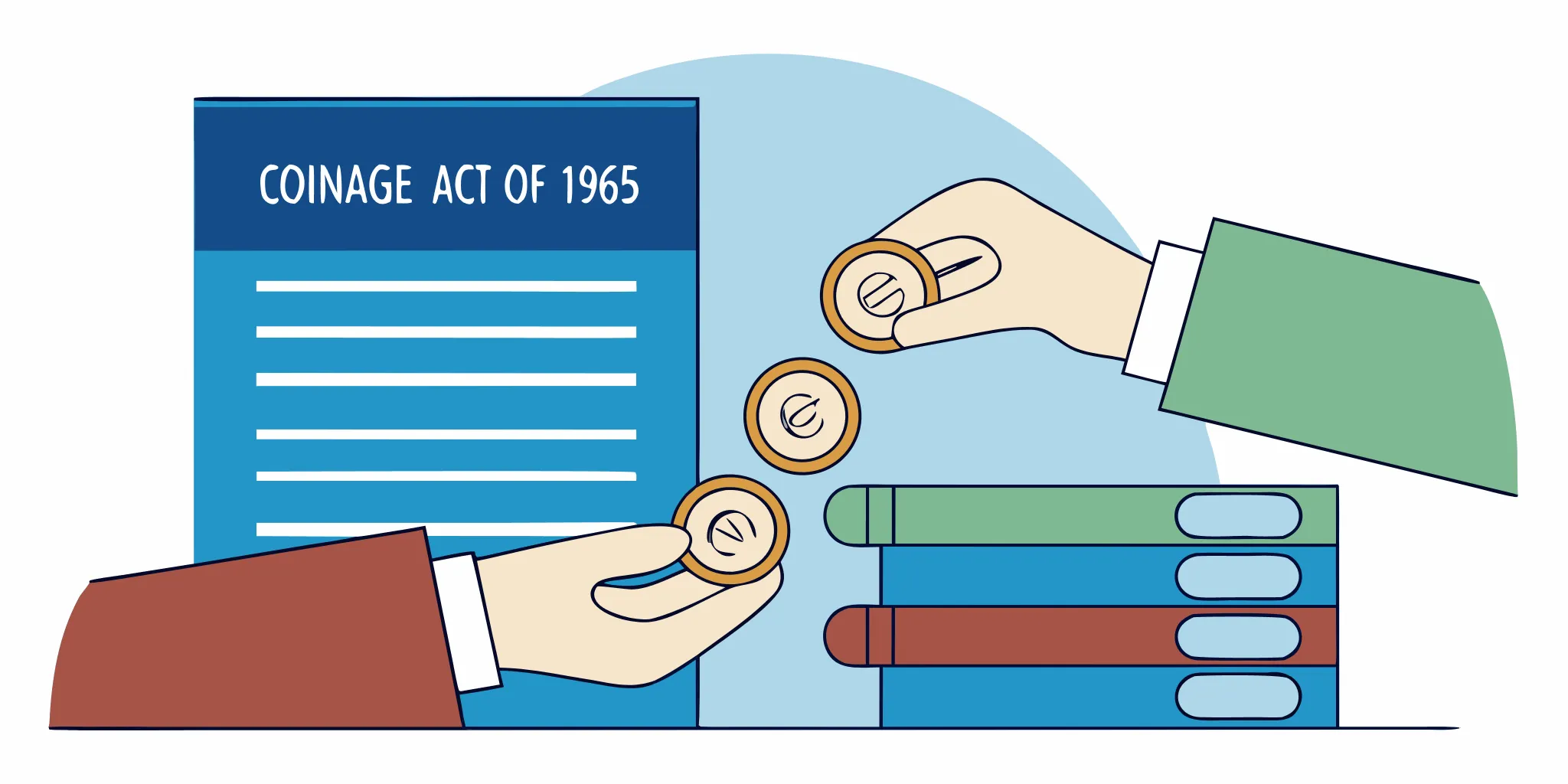
However, starting in the early 1960s, economic conditions in the US and globally began to change fast.
High industry demand for silver, especially in electronics, photography, and jewelry, together with stable government demand for coin production, caused government-controlled silver reserves to become low quickly.
| Coin | Time Made (90% Silver) | Mix by the 1965 Act (1965–Present) |
| Dime | Before 1964 | Copper-Nickel Clad |
| Quarter | Before 1964 | Copper-Nickel Clad |
| Half Dollar | Before 1964 | 40% Silver Clad (1965–1970) |
| Half Dollar | Before 1964 | Copper-Nickel Clad (From 1971) |
The Crisis and Reasons for the Law
When the metal value inside a coin is more than its face value, Gresham’s law starts working: “bad” money pushes out “good” money.
Collectors, people buying for profit, and normal citizens started taking out silver coins from circulation in large numbers.
They either kept them as a money investment, waiting for the silver price to go up more, or melted them down for the metal, resulting in a severe lack of 10-cent, 25-cent, and 50-cent coins for daily trade, causing serious trouble for businesses and buyers.
The US government tried for several years to keep the silver price low by selling its reserves at a fixed price, but this method didn’t work against the growing market demand.
By 1965, it became clear that solving the coin shortage was impossible without a big change in the coins’ metal mix.
In 1964, the US Mint, responding to the shortage, made a new decision: freezing the date on all coins, including silver ones, by making coins dated “1964” throughout all of 1965.
This was done to stop collectors and people buying for profit from taking out more coins from use, creating an idea that the 1964 coins weren’t rare.
But this measure was short-term, failing to fix the main problem.
Main Parts of the 1965 Coinage Act
The first major change was the full removal of silver from dimes and quarters. The silver content in the Dime and Quarter was completely stopped.
Coins made after 1965 started to be made from a new clad material, having three layers: the outer layers consisted of 75% copper and 25% nickel, while the inner layer was pure copper.
This total mix, making the coin 91.67% copper and 8.33% nickel, took away their real value tied to silver.
The second change was reducing silver in the half dollar. This coin kept silver, but its content was lowered from 90% to 40%.
The coin also became clad, containing silver in its structure: the outer layers were 80% silver and 20% copper, and the inner layer was 21% silver and 79% copper.
President Johnson personally wanted to keep some silver in these coins, aiming to avoid the feeling of completely breaking with tradition.
The law also temporarily stopped the making of 1-dollar coins. This action was necessary because of the high silver price and the risk of new silver dollars being taken out of circulation right away.
Finally, the law introduced a ban on melting down coins and sending them to other countries, seeking to keep circulating silver coins in use for as long as possible until the new clad material filled the market.
Economic and Social Effects
The 1965 Coinage Act had several quick and long-term effects, changing the coin collecting and economic situation of the US forever.
Solving the Lack Problem: The new copper-nickel coins, having no real metal value, stopped being something people bought for profit.
The coins stayed in use, doing their job, because their face value was more than the value of the metals inside them.
Within a few years after 1965, the problem of a lack of change coins was largely fixed.
Starting “Clad” Coinage: From 1965, the copper-nickel mix became the normal material for dimes, quarters, and later for the half dollar.
This marked a complete end to linking change coins to the value of precious metals.
From this time, a coin’s value was set only by the government’s promise, not by its physical metal mix.
Changes in Coin Collecting: All 10-cent, 25-cent, and 50-cent coins dated 1964 became the last ones made from 90% silver, making them valuable for collectors and investors, despite large numbers being made, but anyway use a coin scanner app to know for sure.
The half dollar coins made from 1965 to 1970 became a special “transition” group, containing 40% silver, and these coins also quickly disappeared from use, since rising silver prices made their metal value also higher than their face value.
The Final Removal of Silver: More price increases for silver resulted in even the 40% silver half dollars being taken out of use. In 1970, an extra law was passed, completely taking out silver from the mix of the half dollar.
Starting in 1971, the 50-cent coin was made from the same copper-nickel clad mix as the dimes and quarters.
So, by 1971, silver was totally removed from all standard American change coins, excepting special memory coins and investment coins.
Finding Clad Coins
Coins made of the copper-nickel mix after 1965 are easy to tell apart by the copper line, visible on the side edge of the coin.
This copper line is the bare inner core of the coin, squeezed between the two outer layers of nickel and copper.
Silver coins made before 1964 don’t have this copper line, since their mix is the same — don’t worry if you’re confused with all the details, use a coin value checker.
The Coinage Act of 1965, being mainly an economic fix, let the US Mint make money circulation stable despite the rising prices of precious metals.
It marked the US’s final switch to a coin system based on value guaranteed by the government, not on the real value of the metal.
This law led to US coins becoming more stable against market price changes for raw materials, giving a steady and enough supply of change coins for the economy’s needs, but taking away the long-standing tradition of using precious metal in circulating coins.
Recent Posts



Our partners:
Undercurrent Voices© 2026. All rights reserved.