
1999 Connecticut Quarter Errors: Real Mint Mistakes vs Post-Mint Damage
The phrase 1999 Connecticut quarter errors attracts a lot of attention because this coin is easy to overlook. The reverse has a detailed tree, thin branches, small letters, and many places where marks can look dramatic. That is why this quarter teaches one useful lesson: not every strange line came from the Mint.
A good error article must do one thing first. It must separate real mint-made defects from later abuse. That is the point here. This is not a list of every odd-looking quarter. It is a practical review of what belongs to the minting process and what belongs to circulation, storage, or rough handling.
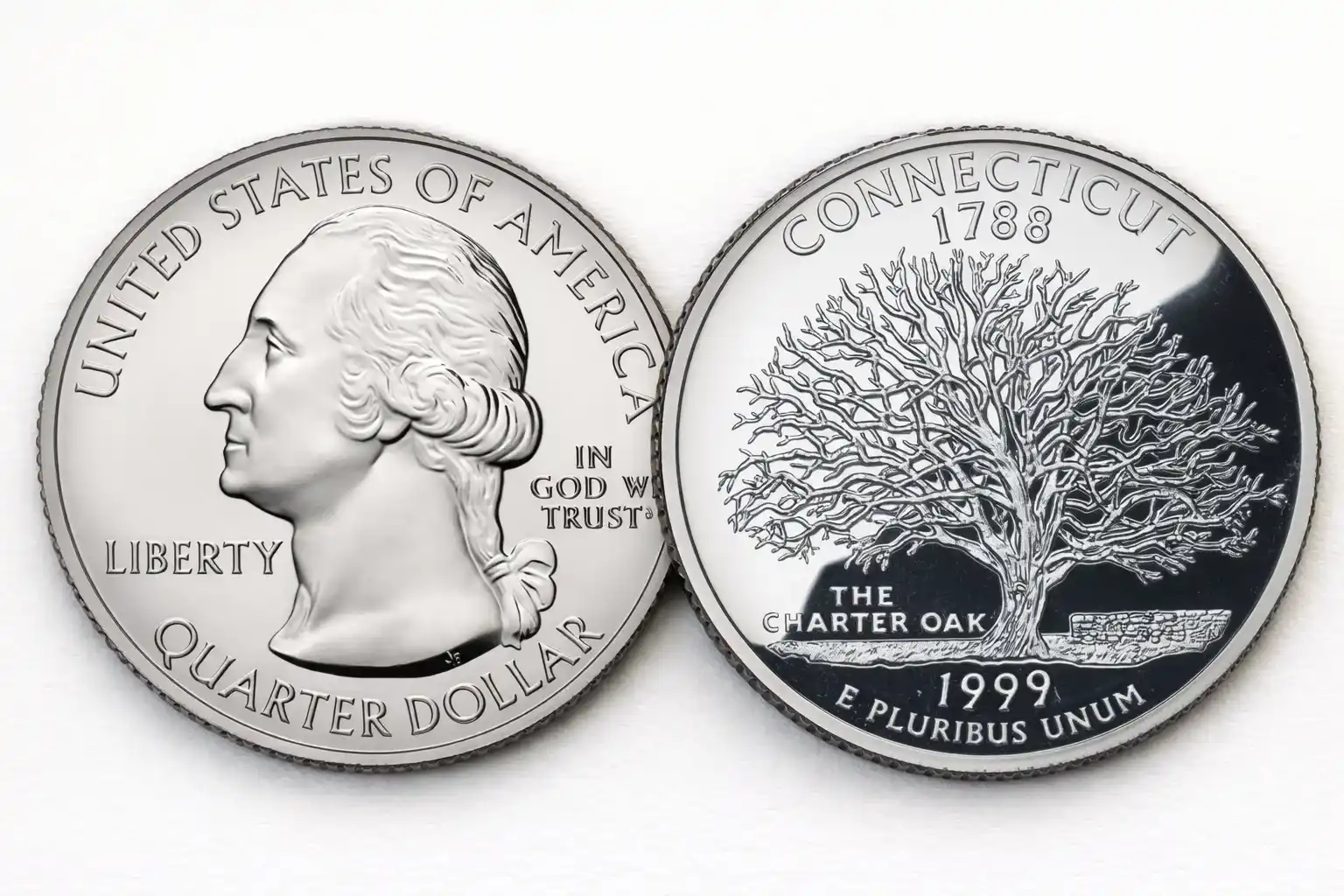
What Coin Are We Checking
The 1999 Connecticut quarter is part of the 50 State Quarters Program. It was released on October 12, 1999, as the fifth and final state quarter of that year. The reverse shows the Charter Oak. The obverse uses the familiar Washington portrait used across the series.
For normal circulation, the coin was struck at Philadelphia and Denver. San Francisco struck proof versions for collectors. That matters because a proof coin can show different surface issues, and collectors should not mix proof quality with ordinary circulation wear.
The design itself causes part of the confusion. The tree fills much of the reverse. The branches split, overlap, and taper into thin lines. That makes the coin easy to misread. A scratch can look like a branch. A clash remnant can look like doubling. A weak strike can look like a missing detail.
Basic Specifications Before Looking for Errors
Before checking for any possible errors, confirm the coin itself.
| Parameter | Standard specification |
| Denomination | Quarter dollar |
| Year | 1999 |
| Design | Charter Oak |
| Circulation mints | Philadelphia and Denver |
| Proof mint | San Francisco |
| Weight | 5.67 g |
| Diameter | 24.30 mm |
| Edge | Reeded |
| Composition | Copper-nickel clad |
These baseline facts matter because some major errors change weight, shape, or striking format. If the coin matches the normal profile, the next step is not to assume it is ordinary. The next step is to inspect how the design sits on that standard coin.
Use a coin value checker free to easily confirm the type, date, and normal specs. It cannot decide whether a mark is a die crack, a scratch, or a hit from circulation. That part still depends on visual inspection.
What Counts as a Real Mint Error
A real mint error begins before the coin leaves the Mint. The problem starts with the blank, the die, or the strike. The defect is part of the coin as made. It is not something that happened later in a cash drawer, a parking lot, or a counting machine.
The main groups are simple:
- Die errors
- Strike errors
- Planchet errors
Die errors include cracks, chips, cuds, clash marks, and confirmed doubled dies. Strike errors include off-center strikes, broad strikes, double strikes, and struck-through pieces. Planchet errors include clips, wrong planchets, and metal flaws tied to the blank itself. Those are the categories worth learning first because they follow the minting logic.
That logic matters more than the visual shock of a mark. A real error usually makes sense when you ask one question: could this happen during production? If the answer is no, the coin is usually damaged, not rare.
Why This Quarter Gets Misidentified So Often
Connecticut is one of those state quarters where collectors often focus on the branches. That is where many claims begin. A line near a branch gets called extra detail. A flat shelf is called doubling. A random scrape gets called a variety.
This is exactly where caution helps. Wexler’s Connecticut listing states that the apparent doubling of branches halfway up the tree is the result of a die clash, not a doubled die. It also notes that the original WDDR-001 through WDDR-006 were reexamined and found to be die clash remnants, with those listings to be replaced. That is a strong reminder that even specialists can revise earlier attributions.
This point makes the article stronger than a simple error list. It shows why the question is not “Do I see something unusual?” The better question is “What caused it?”
Real Mint Mistakes Collectors Should Check First
The safest starting point is the group of errors that are easy to separate from damage.
Die cracks and die chips
These are common enough to understand and easy to confuse with damage if the photos are poor. The key sign is raised metal. A crack in the die creates a raised line on the coin. A cut or scratch after circulation cuts into the surface. That difference is basic, but it solves many wrong calls.
Die clash remnants
This category matters a lot on the Connecticut quarter. A clash happens when the dies hit each other without a planchet between them. Marks from that event can transfer into later strikes. On this coin, the branch area is where collectors often get fooled. A clash remnant may look like doubling if the viewer wants to see a doubled die.
Off-center strikes and broadstrikes
These are stronger visual errors. They are easier to recognize because they change the whole coin, not just one detail. With an off-center strike, part of the design is missing because the blank was not centered. With a broad strike, the coin spreads without the collar containing it. These errors usually attract more attention because the cause is easier to explain.
Struck-through errors
A struck-through happens when foreign material gets between the die and the planchet. It blocks part of the design. These can be interesting, but they still need caution. A later gouge can also remove detail. The difference is that a real struck-through fit the strike, while a later hit usually looks random.
Wrong planchet errors
These sit in a more advanced category. They are not the usual find. They matter because they change the coin in a bigger way, often through weight, color, or size. A normal-looking Connecticut quarter with a few odd marks is far more likely to be damaged than to be a wrong-planchet coin.
What Usually Turns Out To Be Damage
Most “error” finds are not mint errors. They are ordinary damage with a strong visual effect.
The most common false alarms include:
- Scratches in the fields
- Rim hits
- Flattened reeds
- Corrosion or staining
- Shelf-like machine doubling
- Random lines through the tree
These marks do not follow minting logic. They follow use. They happen after the coin enters circulation. They may still look unusual, but they do not carry the same collector weight.
Machine doubling is another trap. It can create flat, shelf-like outlines that look dramatic in photos. It is not the same thing as hub doubling. It does not have the same status, and collectors should not price it like a true doubled die. Wexler’s note about the Connecticut branch area makes this point even clearer.
Environmental damage also fools many beginners. Dark patches, rough surfaces, and odd color shifts can make a quarter look special. They usually do the opposite. They reduce appeal and remove any real premium unless the coin has a separate, confirmed mint error.
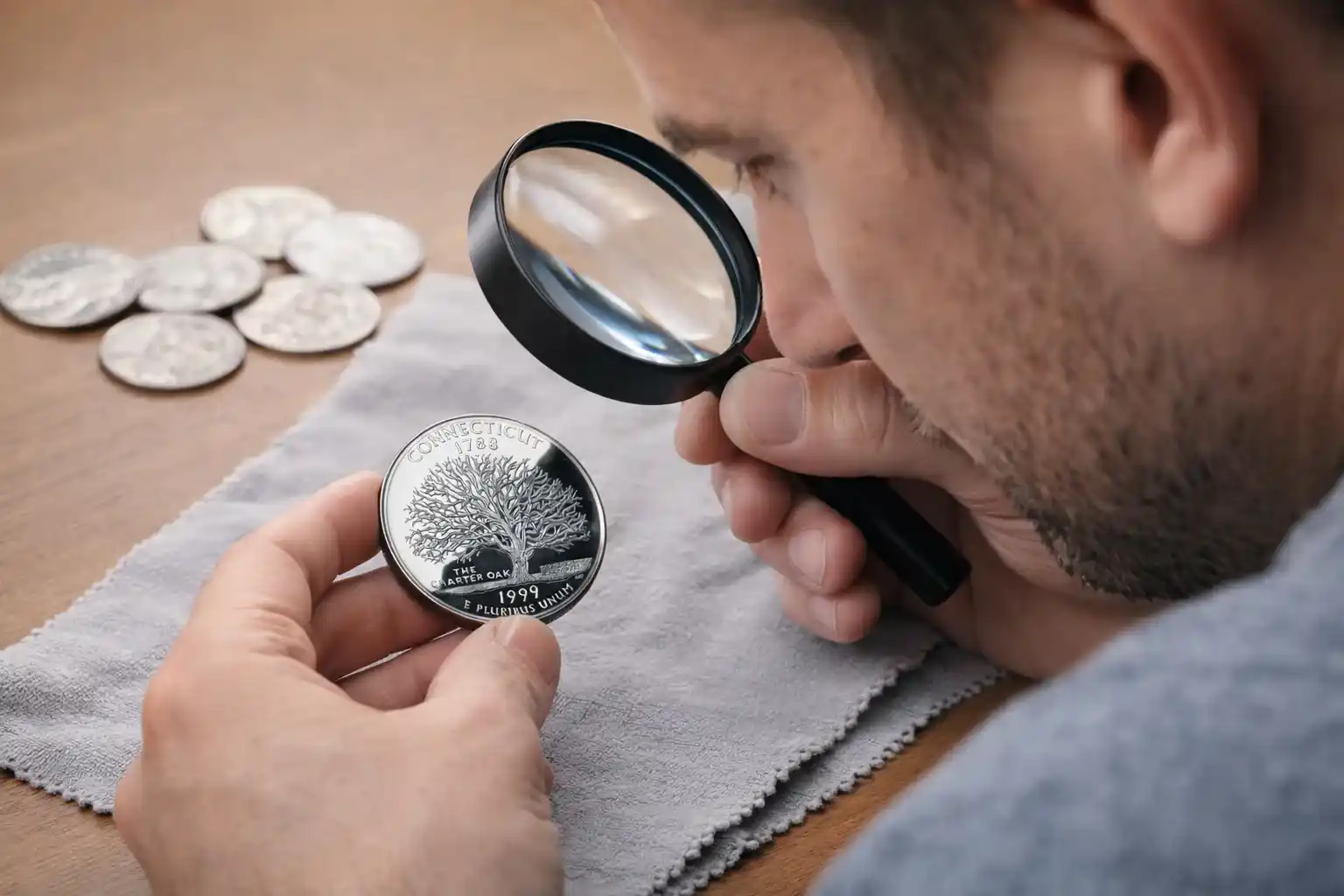
A Simple At-Home Check
Before calling a coin an error, ask these questions:
- Is the metal raised or cut into the coin
- Does the feature follow the design in a logical way
- Does it look random or repeated
- Is the coin still within normal specs
- Is the area one that often causes false alarms
On this quarter, inspect these zones first:
- Tree branches
- Lettering
- Rim
- Date area
- Edge reeds
- Open field around the oak
This is not expert grading. It is a basic sorting discipline. It saves time and reduces bad attributions.
How Value Works for Connecticut Quarter Errors
Normal 1999 Connecticut quarters are common. Philadelphia struck 688,744,000 pieces for circulation, and Denver struck 657,880,000. That means ordinary worn coins remain face-value pieces. A strange mark does not change that by itself.
Value starts when the defect is real, visible, and explainable. The market reacts better to clear off-center strikes, broad strikes, wrong planchets, and other strong mint-made errors than to small, ambiguous marks.
| Category | Typical market reaction |
| Normal circulated coin | Face value |
| Small unconfirmed mark | No premium |
| Clear minor mint error | Small collector premium |
| Strong visual strike error | Higher premium |
| Rare major mint error | Specialist interest |
This is why attribution matters. A weak claim with poor logic usually stays weak in the market. A strong error with a clear cause stands on firmer ground.
Practical Advice for Collectors
Save the coins that clearly deserve a second look.
Good candidates include:
- Off-center strikes
- Broadstrikes
- Major die breaks
- Clipped planchets
- Wrong planchet suspects
- Clear struck-through pieces
Do not over-save these:
- Light scratches
- Worn rims
- Small contact marks
- Random branch lines
- Flat machine doubling
- Coins with only environmental damage
A coin checker is useful only as a first-pass tool. Coin ID Scanner can help compare baseline value ranges, confirm the normal coin profile, and keep possible finds organized through collection management. That is useful when you are sorting many state quarters. It still does not replace inspection. Real attribution comes from the coin itself, not from the first scan.
Conclusion
The Connecticut quarter is a good coin for learning the difference between a real error and a false alarm. The design is detailed. The branch area creates confusion. The market is full of claims that sound better than they look in hand.
The best approach is simple. Confirm the coin. Learn the difference between raised and incuse marks. Treat the tree carefully. Do not confuse clash remnants with true doubled dies. Do not confuse damage with rarity. That is how a collector moves from noise to good judgment.
Recent Posts



Our partners:
Undercurrent Voices© 2026. All rights reserved.